
Book Review: “The Shack” by William P. Young

 January 26, 2010


I believe there are as many ways to God as there are beings in this universe.

The Shack by William P. Young is about how one man finds God through the atrocity of his young daughter’s murder.

This book reinforces some of the truths I’ve learned on my own journey, primarily the discovery of God in unexpected places and times in our lives.

I also find it interesting that the author mentions music and musicians here, and references James Taylor, Bob Dylan, Moby, Sarah McLachlan, Jackson Browne,  Bruce Cockburn and the bands U2, Indigo Girls and Dixie Chicks, to name a few.

Kudos to The Shack for portraying God as alternating between male and female personifications and for depicting God as more than one spiritual entity. For me, these were the book’s shining moments.

I did however, have a few problems with this book. The main issue was that it is a bit too slanted toward Christianity. Although the author goes out of his way to say this isn’t the case, I found some of the concepts confusing. For instance, Young assumes that everyone practices a rite called “devotions.” I had no idea what he was talking about.

I also think that due to the manner in which the story is presented, it excludes a lot of people. Not everyone sees God within the context of Christianity or religion. The Shack makes reference only to The Bible, as if it were the only holy text, whereas there are other books out there that also contain universal truths. Tao Te Ching, for instance, is even older than The Bible.

In any case, this book is written, as all books are, from the author’s perspective, which includes that which he believes to be true and that’s why I forgive these “indiscretions.” There is still a light in this book that will inspire many.

That being said, neither do I think it’s wrong to see God within the context of Christianity or religion. However one discovers God is great. It only matters that you find Him/Her/It/Them–whatever your definition of the Divine may be, and that you realize you are an important part of the Magnificence—that which is in you and also all around you.


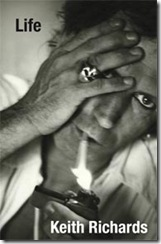
Book Review: “Life” by Keith Richards

April 27, 2011

Although the Rolling Stones’ “Jumpin’ Jack Flash” was released in 1968, I think the first time I heard it was the summer of 1972, when I was between 8th and 9th grade. I went to a dance at my high school and a local band was playing that song. It was LOUD. I remember standing there on that wooden floor in the gym and trying to absorb the sound. It rocked like nothing I had ever heard. Up until that point, I’d lead a pretty sheltered life in Catholic school, and since we’d just moved to another state and I was finally going to be attending the public school in the fall, that was the first time I’d actually been exposed to the real world, so I wasn’t even quite sure what “rocked” was; I just knew the song got me in the gut, a place where “Put Your Head on My Shoulder” by The Lettermen—a song my best friend Mary-Beth used to listen to—couldn’t come close to touching in me.

In his newly-published autobiography, “Life,” Keith Richards understands this. He writes, “It’s not something you take in the head, it’s something you take in the guts.”

And later he says,

That feeling is worth more than anything. There’s a certain moment when you realize that you’ve actually just left the planet for a bit and that nobody can touch you … and when it works, baby, you’ve got wings. You know you’ve been somewhere most people will never get … it’s flying without a license.

This is what I’m talking about. Need I explain further? Nope.

When I think of Keith Richards, what initially comes to mind is drugs, drugs, drugs, rough and tough, “Street Fighting Man” rock and roll, and Robin Williams’ joke about how if everyone in the world were to perish due to chemical warfare, the only things that would survive would be Keith Richards and cockroaches.

So when I read “Life,” I was surprised and impressed that after all the drugs he’s done, Richards is articulate, intelligent and well-read. It’s a long book, 547 pages, including pictures of Keith growing up in England, on the road with the Stones and performing with various artists like Chuck Berry, Paul MCartney, John Lee Hooker, Tom Waits, and others. My favorite however, is a picture of Keith, barefoot and lounging on a settee while strumming his guitar in the middle of his library at his house in Connecticut. There are books and pillows scattered everywhere, bottles and debris all over the desk, record albums lined up on the bottom shelves and a handwritten sign that reads “Keith Richards Main Offender.” If a picture is worth a thousand words, I think that photo pretty well sums up my impression of him after reading his book.

Other than Richards’ intelligent mind, what impressed me the most was his repeated acknowledgment of the fact that he doesn’t feel like he’s better than anyone else and that all he really wanted and still wants to do, is play the blues. He writes:

It was all dripping with sexual lust, though they [girls in the ‘50s and ‘60s] didn’t know what to do about it. But suddenly you’re on the end of it. It’s a frenzy. Once it’s let out, it’s an incredible force. You stood as much chance in a fucking river full of piranhas … These chicks were coming out there, bleeding, clothes torn off, pissed panties, and you took that for granted every night. It was the gig. It could have been anybody, quite honestly. They didn’t give a shit that I was trying to be a blues player.

Later, he says,

…maybe some of the songs opened up their hearts a little, or their minds, to the idea of we’re women, we’re strong. But I think the Beatles and the Stones particularly did release chicks from the fact of ‘I’m just a little chick.’ It was not intentional or anything. It just became obvious as you were playing to them. When you’ve got three thousand chicks in front of you that are ripping off their panties and throwing them at you, you realize what an awesome power you have unleashed.

Each observer feels something different when experiencing art, be it a book, a concert, a photograph, or what have you. For me, the aspect of this book that really stood out was the human element—how the music of the Stones changed people—especially women, because that’s a very important element of my book too. And if I could just put my finger on exactly what that is… I keep trying.

In any case, just hearing it from Keith’s perspective makes me feel like he and I share an understanding of something that’s greater than what’s on the surface. And while he writes about some technical guitar stuff and his relationship with Mick Jagger and the others involved, this book is not written with the expected “I’m a big star, worship me” kind of attitude. How refreshing. Richards shares with us how it feels to be Keith Richards—his frustrations and joys with drugs and being labeled an “outlaw” (which he ultimately decided he might as well live up to), the rush of being onstage in front of thousands of people, and how it felt when his and Jagger’s songwriting jelled.

This is what makes “Life” such a great read, because through Richards, I too, can experience what that must have been like. But those same feelings are available to all of us. I don’t mean that we can, or should aspire to be Keith Richards or Mick Jagger or even musicians, or that we should do drugs. I mean that by discovering whatever it is in our own lives that brings us those same feelings that completely fill us up, we can be whole. And that’s what life and “Life” is all about.

Thanks for sharing, Keith. Incredible, awesome book.

For more information, please click the image above.

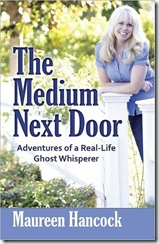
Book Review: “The Medium Next Door: Adventures of a Real-Life Ghost Whisperer” by Maureen Hancock

May 19, 2011

       Maureen Hancock

Is there really such a thing as ghosts? Is it possible the living can actually communicate with them?

I don’t know if it’s due to nature of my own book, (coming soon) that I’m more attuned to this sort of thing or what, but there seems to be a change in the world’s consciousness lately. People are becoming more open-minded when it comes to the subjects of supernatural phenomena, spirits and spirit mediums—those who communicate with the dead.

Maureen Hancock’s new book, The Medium Next Door: Adventures of a Real-Life Ghost Whisperer, is about this very subject. Her book is a cross between self-help, grief counseling and memoir. Hancock relates the story of how she was drawn to this unusual profession and shares her adventures along the way, culminating with her rise to nationwide popularity due to her warm, caring personality and her uncanny ability to interact with the deceased. She is currently in the process of filming her own reality TV show for Disney, premier date to be announced.

As a toddler, Maureen nearly died due to lead poisoning from ingesting lead-based paint from a windowsill in her house. To this day, she believes that her near-death experience was the means that opened her spirit to receive messages from beyond, because around the age of 5, she began to see “ghosts.”

Through the years, her psychic abilities grew until she could no longer deny the gift she’d been given. Maureen now uses that gift to help others. This is the most touching part of her story. The author doesn’t ask you to believe her, she seems only to want to educate others that death is not the end and that love never dies. Along with her charity, Seeds of Hope, her mission is to help others triumph over the loss of their loved ones and to live life to its fullest—and not necessarily because that’s what their loved ones would want, but because that truly is the reason for our lives—to experience as much joy as possible and to share it with others. She also works with and has earned the trust of many law enforcement agencies.

The Medium Next Door has a universal appeal because if we haven’t already, eventually we will all lose someone we love. My favorite chapter was “Tales from the Trenches,” where Hancock recounts episodes that made me laugh; a great virtue, I think, when it comes to the serious nature of her work.

The only criticism I have is that I would have preferred the author followed the book with a workbook instead of inserting lessons at the end of the chapters. While I enjoyed both her experiences and her wisdom, I thought the lessons distanced me somewhat from the story flow. And I would have liked to have read in more detail about how one can develop intuitiveness for one’s self. Maybe that will be Hancock’s next book. I hope so.

Other than that, a great read from what appears to be a woman of boundless energy, sunshine and joy. Her stories are entertaining, funny and inspiring and she has made a believer out of me. The Medium Next Door is sure to touch your heart as well.

For more information, please visit www.maureenhancock.com, or to purchase her book, click on the cover below.